

Getting a return on investment from employee engagement surveys
Many organisations are committed to engaging their employees and invest in running employee engagement surveys – yet so few achieve the improvements in engagement levels that really do have a positive impact on business results. Here we discuss what is meant by engagement and what organisations can do to reach new levels.
Engagement in a nutshell
First of all, let’s look at what engagement is and the prize of measuring and managing it as a strategic priority.
There are many definitions of employee engagement – but most agree on a few core themes: the commitment, enthusiasm and the willingness of employees to invest discretionary effort in doing a great job for their company that leads to better business results. But what drives employee engagement?
Engagement versus satisfaction: is it just semantics?
The best surveys measure with what we call true ‘engagement’, rather than ‘satisfaction’. The latter tends to assess what we call largely ‘hygiene’ factors – the extent to which people are happy with various aspects of their physical work environment and extrinsic rewards: satisfaction their pay and benefits, parking arrangements, the communications they receive and so on.
An employee, however, could well be satisfied and have no immediate thoughts of leaving the organisation – but it doesn’t mean to say they are productive at work or strive to do a great job. This is a lost opportunity for any company.
Engagement is the true prize. And the foundations of engagement are very different to satisfaction. Here we are measuring how well the organisation – but particularly the managers they work for – are meeting their employee’s fundamental needs at work. These include the opportunity for self-actualisation and development; meaningful (and not necessarily financial) recognition for doing a great job; having a supportive manager to help them to perform well at work; and having a sense of purpose in their role and seeing how it connects to the organisation’s goals. These are very different to the types of questions commonly included in satisfaction surveys, going to the heart of individual motivation and growth.
The engagement ‘prize’
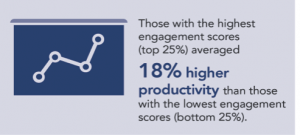
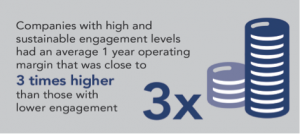
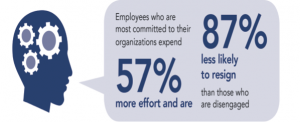
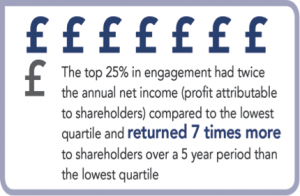
And what’s the prize of getting the right engagement survey questions? We know from our research that measuring true engagement and then taking action to enhance it has a measurable impact on business results – productivity, retention, and profit margin to name but a few. Here are just a few examples:
Why engagement efforts stall
This is all well and good – but many organisations’ engagement efforts stall when it comes to what to do with the survey results, beyond communicating them to staff. There is an old British saying that goes: ‘You don’t fatten a cow by weighing it’. The same is true of engagement: organisations cannot improve it by merely by measuring it. Quite the opposite, in fact. Running a survey and not doing the right follow up can be worse than not having measured in in the first place. Why? If employees see that nothing is done with the survey results they believe their organisation is only paying lip service to engagement and that it isn’t really interested in their views after all.
Getting traction through engagement action planning
Many companies have the right idea about action planning. However, this is usually limited to the Executive or Management Committee – or worse, the HR department. This is well-intentioned but misses the fact that the bulk of the research, OSC’s included, points to the immediate line manager has the biggest impact on employee engagement, whether positive or negative. This explains why an organisation operating in one country, working within the same national culture, the same economic and political environment, the same vision and mission, and having the same HR policies and practices, will see a huge range in engagement results across managers and departments. This variation is explained unequivocally by the line manager. He or she creates the micro work climate that enables his or her team to flourish – or not. An oganisation may have great reward or training policies- but it is the managers that applies them.
For this reason, the most effective engagement action planning is led by line managers – not by the Executive or by the HR department. In our experience of manager-led action planning, when employees respond to survey questions, it is based on their own personal experiences, values and interpretation of life at work. So one employee will respond to a question in a different way to another. Or indeed, may respond in the same way, but for a different reason. Take the classic question dealing with whether an employee has the right tools and resources to perform effectively. One team member, depending on their role, may base their response on considering whether their computer has enough memory or the latest version of Office to help them work quickly; another’s assessment may come down to whether they feel their manager is giving them sufficient information and updates to do their job well.
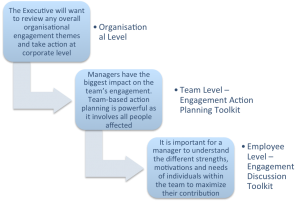
So, the risk of only the Executive conducting action planning is it assumes every employee is the same and that they know what was in every employees’ head when they responded. And worse, they may assume junior employees have the same interests and motivation as themselves. Having said that, there is clearly is a place for top level action planning – but we recommend limiting this to 2-3 areas that the top team alone can impact.
So we recommend organisations also look at a strategy of manager-led action planning. By facilitating a structured discussion with his or her staff about that team’s or department’s engagement survey results – then doing something with these insights – a company has a much better chance of increasing engagement levels. Here managers can surface what was in the minds of his or her employees when they completed the survey; what areas of engagement strength exist that they can build on even more; what areas need to be improved and how. By getting employees to share their insights and to suggest actions the team can take – and that are within their control – this creates greater ownership and commitment to action. All that’s then needed is discipline in following through and implementing what the team has agreed. We’ve found that this process has the biggest impact on team engagement.
OSC has captured this experience in our Engagement Action Planning Toolkit, a step-by-step guide for managers on how to facilitate this type of engagement discussion, including the types of impactful questions to ask. We also know that all employees are different. We do not have the same motivations, needs or aspirations. This means that an individual approach to managing a team rather than assuming everyone is the same also helps achieve a step change in engagement. Our Engagement Discussion Toolkit helps managers quickly identify the most effective way to manage each employee to get the best out of them. This contains some exploratory questions managers can use with each employee to really understand what motivates him or her, what talents and strengths the employee has that are being-utilised and how they could be used more effectively, and how he or she likes to be recognised. In short, how is that individual ‘wired’ and what the manager can do to maximise their engagement.
Three Levels of Engagement Action Planning
In summary
So, in short, organisations serious about driving engagement to impact business results should adopt not only the right engagement survey, but ensure they focus their energy on action planning and follow through at organisational, team and individual level to get real traction for the benefit of their staff, customers, shareholders and other stakeholders .